

Modeling multimodal
clinical and
neurobiological data
using deep pattern
discovery
Systems-Level Structure in Complex Disease
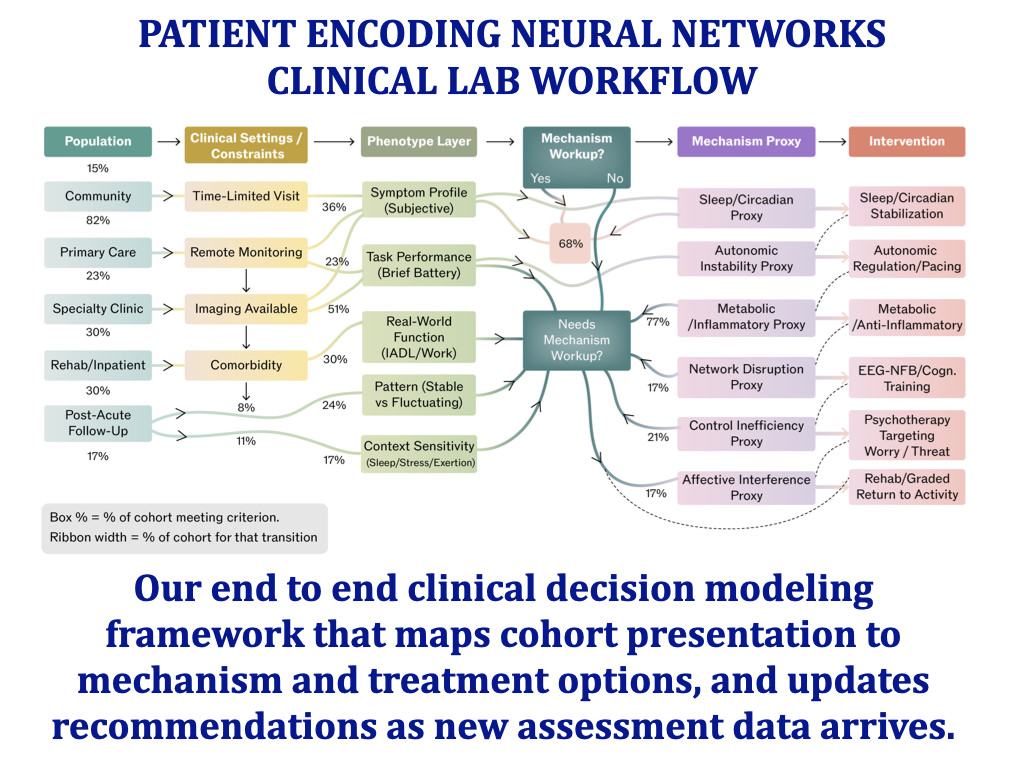
Many conditions involve symptoms that span multiple body systems and change over time. Patient Encoding Neural Networks studies these patterns by identifying data-driven subtypes and tracking how symptom trajectories vary across individuals.

Data and Cohort Engineering
Work at the Computational Research Lab builds analysis-ready cohort tables and patient-level representations from diverse measurement layers, with standardized time alignment, quality control, and harmonized endpoints that enable comparable inference across studies.
Features emphasize harmonization, missing modality handling, reproducible feature engineering, and cohort comparable outputs.
Core Analytical Capabilities
Research outputs emphasize stratification targets, calibrated prediction, and association mapping with validation-oriented evaluation.

Time-aware models for recovery, progression, recurrence, and flare forecasting

Unsupervised clustering for data-driven subtype discovery and stability assessment

External validation and robustness analyses under protocol and measurement shift
Research Programs

Primary programs span neuroimmune cognition science and neuroscience, with additional programs in neurogastroenterology, neurology, and oral-systemic inflammation.
Focus Areas Include:

Neuroimmune cognition: endotypes and trajectories in post infectious and inflammatory contexts

Early cognitive decline: representation based stratification of MCI heterogeneity and progression associated profiles
Gut brain phenotypes: endotyping and longitudinal modeling of neurogastroenterology symptom domains, including flare prediction signals

Neurology trajectories: migraine phenotypes, MS fatigue endotypes, epilepsy trigger profiles, and post stroke cognitive outcomes modeled with multisystem covariates

Oral systemic inflammation: cohort and population scale modeling of periodontal and inflammatory proxies linked to cognitive vulnerability
See how our work drives better patient outcomes.
Methodological Scope
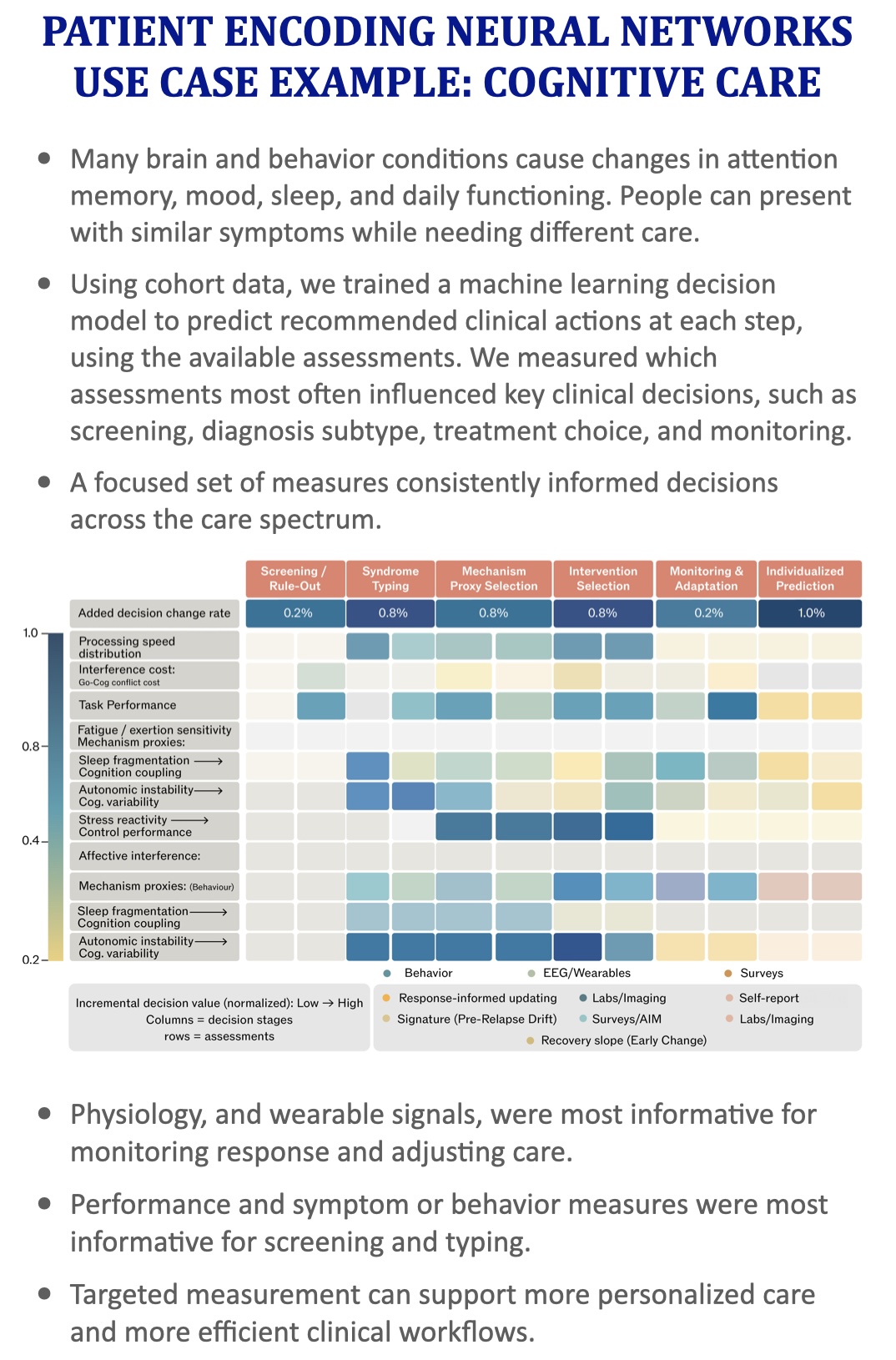
Method development is centered on patient-level representation construction, subgroup discovery, longitudinal inference, and association testing, with generalization as a default requirement.
Examples of Methodologies
- Patient embeddings for high-dimensional cohort representation
- Latent structure discovery for stratification
- Correlation networks and regression-based inference for association testing
- Longitudinal and lagged models for temporal coupling and trajectory estimation
- Multimodal integration across clinical indicators, immune markers, neurocognitive measures, and sleep and autonomic signals
- Robustness analysis and external validation across cohorts and sites
Clinical Impact Highlights

Treatment Selection Criteria
Symptom-mood phenotyping guides selection of dietary vs. CBT-based therapy in IBS

Overtreatment Prevention Tools
Behavioral markers reduce overtreatment in IBD by distinguishing functional symptoms from active disease

Early Dysmotility Detection
Early detection of gastric dysmotility in Parkinson’s patients informs pre-motor intervention strategies

Cognitive Fatigue Typing
Recognition of cognitive fatigue subtypes in functional dyspepsia alters management and therapeutic goals

Microbiome-Guided Therapy
Microbiome patterns influence treatment response in mood-disorder patients with GI symptom overlap

Anxiety-Linked IBS
Longitudinal data support neuromodulator use in IBS with anxiety, reducing reliance on GI-specific agents

Integrated Symptom Care
Integrated care model enhances symptom resolution in patients with overlapping GI-neuropsychiatric conditions
