

Method development, validation, and inference in cohort datasets.
Clinical Investigation
Clinical Investigation
Method development, validation, and inference in cohort datasets.
Introduction

Introduction
Research at Patient Encoding Neural Networks Clinical Lab focuses on learning latent structure from cohort datasets and using that structure to support stratification, longitudinal inference, and mechanism-oriented association testing.
Projects span neuroimmune cognition, early cognitive decline, gut brain syndromes, neurologic outcomes, and oral-systemic inflammation, with emphasis on reproducibility and cross-cohort generalization.
Computational Workflow

Follows a workflow designed for consistent inference across studies and sites.
Key elements include:
- Cohort definition and variable dictionaries with versioned datasets
- Time alignment and endpoint specification for repeated measures
- Latent space construction for downstream clustering and stratification
- Regression and association testing with interaction effects and sensitivity analyses
- External validation and robustness checks under protocol and measurement variation
Measurement Domains
Measurement domains vary by cohort and study design. Domains commonly used across projects include the following.
Symptom and Functional Measures
- GI symptom domains and severity instruments appropriate to the cohort
- Fatigue, pain, and functional limitation measures
- Structured affective and stress measures
Neurocognitive Measures
- Cognitive screening and domain-focused testing aligned to attention, processing speed, and executive function
- Repeated measures designs suited to trajectory analysis
Immune and Inflammatory Measures
- Cytokine or chemokine panels and immune pathway proxies where available
- Inflammatory activity markers aligned to cohort context
Sleep and Autonomic Measures
- Sleep efficiency, fragmentation, and related metrics
- Autonomic proxies such as heart rate variability where available
Methods and Evaluation Targets
Method development emphasizes calibrated prediction, stable clustering, interpretable association testing, and robustness to missingness and site variation. Evaluation targets are selected to match the portfolio, including post-infectious cognitive recovery, early cognitive decline stratification, inflammation-linked cognitive variability, flare forecasting in gut brain phenotypes, and oral-systemic signatures in cohort and population-scale analyses.


- Representation learning for embeddings with missingness-aware inputs
- Unsupervised clustering with stability analysis and subtype characterization
- Regression and correlation-network approaches for association testing and effect modification

- Sensitivity analyses for confounding, measurement error, and endpoint definitions
- External validation and robustness testing across cohorts and sites
Longitudinal and Systems-Aware Study Design
Longitudinal and Systems-Aware Study Design
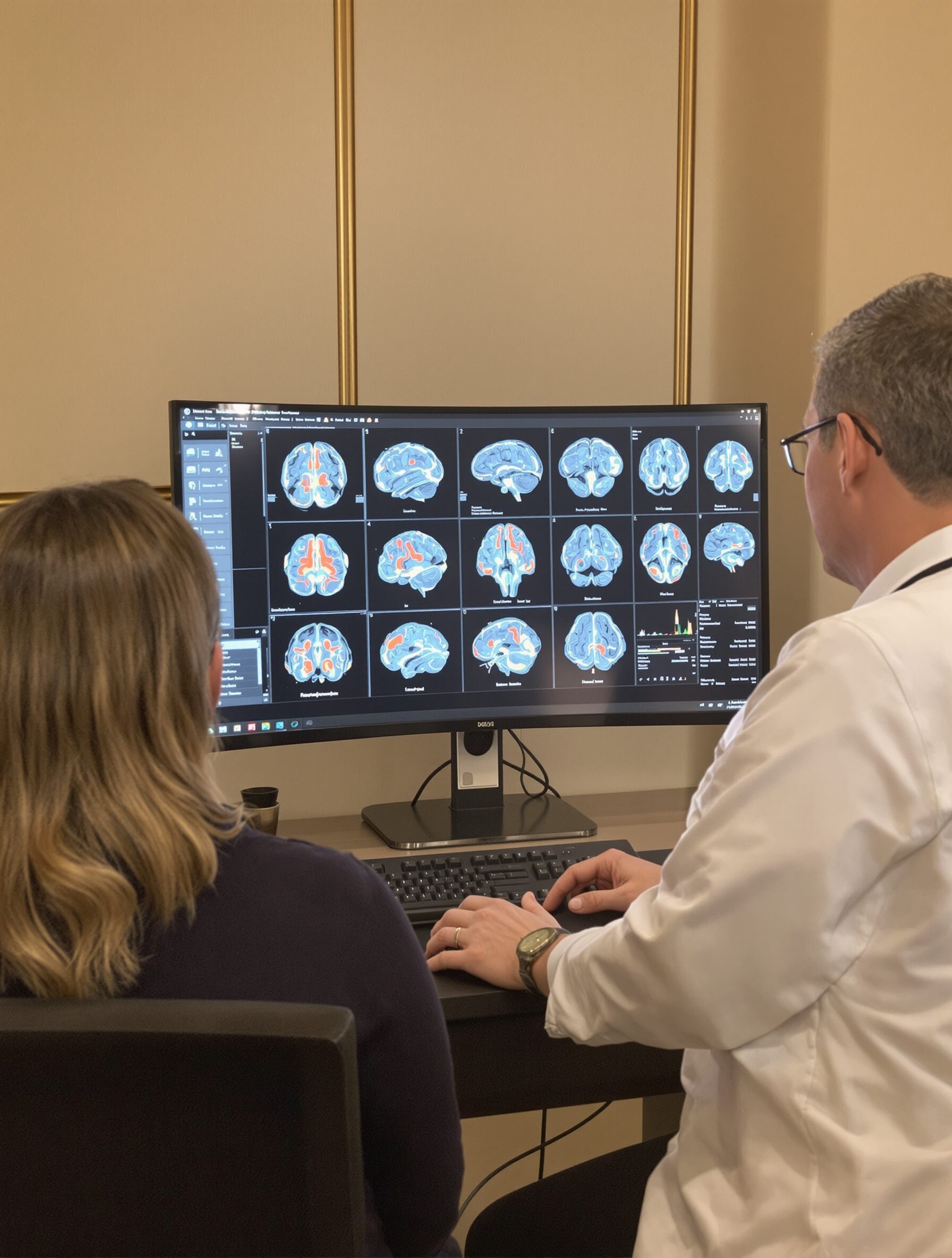
Longitudinal structure is used to estimate trajectories, quantify recurrence patterns, and test temporal coupling between indicators and outcomes. Study designs emphasize time-indexed endpoints, consistent measurement anchors, and analysis plans that remain valid under incomplete follow-up.
Study design characteristics:
- Repeated measures endpoints aligned to cognitive and symptom domains
- Time-indexed modeling aligned to infection events, therapy initiation, or flare windows when applicable
- Missingness-aware evaluation and sensitivity analyses
- Harmonized endpoints enabling cross-cohort comparison
Why This Works

Why This Works
Scientific conclusions require stable stratification, calibrated prediction, and association findings that persist under validation and sensitivity analyses.
Patient Encoding Neural Networks Clinical Lab generates designs that prioritize generalization across cohorts and interpretability of subgroup structure.
- Subtype definitions supported by stability assessment and reproducible characterization
- Prediction models evaluated for calibration, discrimination, and external validation
- Association tests that quantify interaction effects and subgroup-specific relationships
